Sunday

The Perfect Storm of Digital Mediocrity


This is the situation that most organisations are finding themselves in. Let me re-phrase that. This is the situation that most organisations that are behind the curve find themselves in.

In the old world, the product teams were the decision makers. The big kahunas. They owned the vision, the features, the data, and channel implementation strategy. Marketing's job was to be the creative force behind content and execute that vision on the channels. And Digital was a footnote.

In the new world, Digital sales are overtaking physical sales. Customers are researching and making their decisions with the use of social media. Digital marketing and digital products bring delivery costs to zero which means more time has to be spent on the experience rather than the sale.

In this new digital landscape, there is a tremendous overlap between what Products, Digital and Marketing do.


All three believe they own the digital experience. 

All three believe they own the customer contact strategy. 

All three believe they own the packaging of the message. 


And that creates inconsistent customer engagement.


Any organisation stuck in this loop has to define the boundaries for digital media. And that can be done by defining categories of "work":
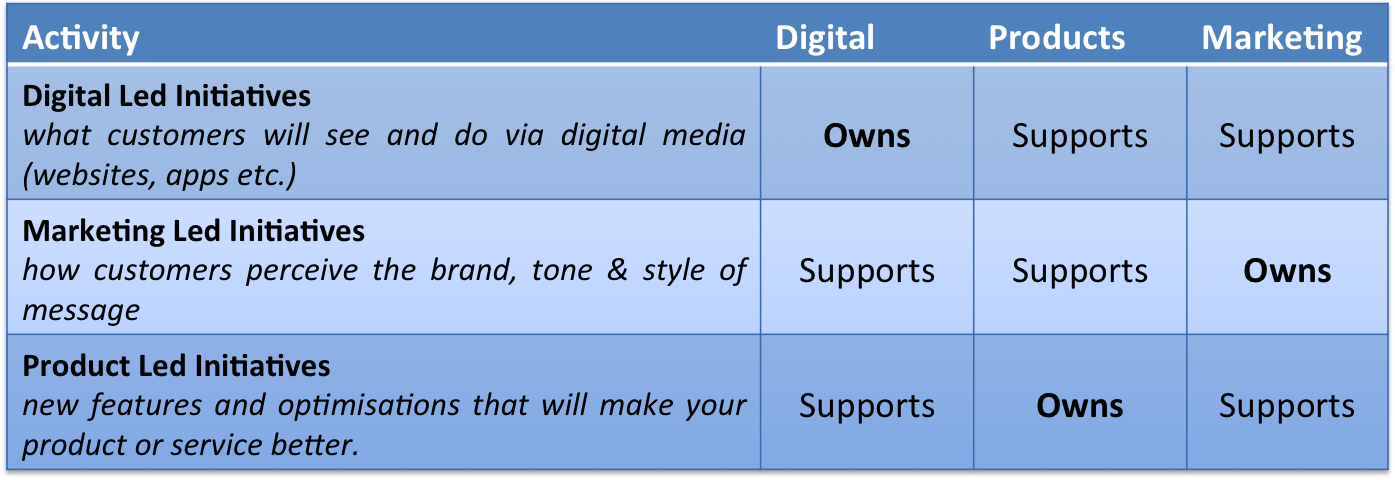


By defining where parts of your customer journey fall in the above, an organisation can start tackling the confusion and create consistent customer treatment. I look forward to your feedback and hearing if your organisation has found a way to remove the noise.


Claims for the digital future.

In the battle to become a great digital organisation, the fight is currently taking place on two fronts - capture as much data as you can and secondly, build a fantastic user experience.

The challenge with data is that most organisations end up becoming data junkyards - where mountains of data is waiting for a superhero analyst to come and make sense of it all. Most companies have started to tackle this in a "Wall-E"-esque way, where relevant insights about customers is pieced together, one product at a time. A few organisations tackle this by customer, piecing together insight on their most valuable segments and providing an awesome experience for those customers.

One thing still remains true: business intelligence is hard. Bloody hard.

Looking ahead at how technology and the market are moving, it is probable that business intelligence will become a lot easier. Three reasons come to mind:

1. Companies will provide Omni-channel customer experiences. Once you stop caring about what channel the customer is in, and you start linking the journey across channels, you take away the headache of building custom channel experiences. Your channels will be controlled in one place. Awesome.

2. Companies will become Device Agnostic. Once wearable technology becomes mainstream, you will no longer be able to keep up with individually tailored solutions for each type of device. Mobile, Desktop and Tablet - will all merge and eventually all you will care about is whether your one common user interface provides an jaw dropping experience or not. Double Awesome.

3. Companies will finally care about privacy and user preferences. The Internet is going the same route as the TV, mainly because it is a targeted media being used in an un-targeted fashion. We're only just realising that. And therefore, by providing the control to users, on customising their experience with your brand,  you will create more loyal followers. This makes it easy for you to send targeted messages to customers - when they want, how they want, and where they want.


The one question that remains is how quickly can you get to a state where channel, device or targeted messaging no longer matters? And what are the obstacles in your industry that are preventing you from getting there? Are you winning the battle today, but losing the war tomorrow?


Tuesday

Fads vs. Trends

Fads are furious and short lived. You need to quickly position your product offering to where a fad currently is. Throw all your short term resources at it. Coming up with extensions will keep the fad going, but it will inevitably die out soon. Then you must look for the next fad.

Trends are slow to build and long lasting. You need to position your offering to where you believe a trend will be. Build your expertise and long term strategy to meet a trend. Extensions are not as necessary and can take on a life of their own. Once you lock into a trend, focus on keeping a competitive advantage.


Love fads. Love trends more.

Thursday

Context matters.

The Wife and I were looking for apartments to rent in London last week. We must have met around 6 real estate agents and seen many more properties. One of the noticeable aspects of the sales process was how important context was to the types of questions asked by the agents.

Only 1 out of the 6 agents asked us how many houses we had seen earlier. When you think about it, the answer to that question determines a lot. If it was the first house we were seeing, it would take something exceptional for us to say yes. If it's the 20th house, we have a lot of reference points to compare the property to. Obtaining this background allowed the agent to customize how she was showing us the properties. Incidentally, we ended up picking a house she showed.

Companies that sell their products online should operate in a very similar way, and the process is faster as well. If I were purchasing shoes, I should be shown related products that match my interest. Depending on where I am in the purchase process, I would be interested in exploring other options, or quickly hone in to the exact product. Either way, the site should be ready to accomodate my needs and consider the context. I feel that most sites do a inadequate job of determining this. Amazon does it well. If you have a business where you are selling products online, how well do you take care of context?

You Only Get One Shot.

Eminem rapped in 8 Mile, "If you had one shot, one opportunity, would you capture it? Or just let it slip?".  Social media works in a somewhat similar albeit less dramatic fashion. Do things right, and your business could have millions of followers that grow at a steady pace. However, make a mistake and most of those fans might leave and never come back.

One of the biggest mistakes is poor content. If you have loyal customers that are willing to track you down, follow you on Twitter or like your Facebook page, then at a minimum you need to keep them there. It doesn't take much. Brands like Barclays quickly realized the price of not having great content and then losing the attention of millions of fans. Don't make that mistake. You have an audience, so go out and wow them.