Monday

The Perfect Choice


In a 2000 whitepaper titled “When Choice is Demotivating: Can One Desire Too Much of a Good Thing?” Sheena S. Iyengar and Mark R. Lepper from Columbia University conducted a series of experiments that demonstrated how having too many options can be a debilitating factor for customers. This now famous experiment, set up two displays in an upscale grocery store - one which had a choice of 6 jams and one which had a choice of 24 jams.
The result? Customers were 10x more likely to buy from the display that hadfewer choices.
Fifteen years later, the concept of choice has gone through significant evolution, especially for online businesses. This can be broken into 3 phases - 
Phase 1: Choice is King (2000-2006)
During the initial dot com bubble and in subsequent years after, the focus was all on the universe of choice available. Data maturity was still nascent and the best organisations were good at managing the data that they directly owned. Content wasn’t necessarily the focus since there were limited big players in most categories. Consumers were not as overloaded and subject to around 150 - 250 pieces of marketing in a given day.
What this meant was that the best way to attract customers was to give them an unparalleled choice. Businesses such as Netflix increased their subscription base from 300k to around 4.2 million by 2005 (even though the streaming service was still 2 years away). Pandora Radio also came into being during this time, and we had access to an enormous library of music, as never before.
For a while, everyone was happy.
Phase 2: Curation is King (2006-2013)
Soon, there was a lot of data available for organisations to mine. And by making initial inroads to understanding this mountain of data, the best organisations were able to start generating smarter recommendations. Shopping carts were tracked. Previous purchases were recorded. Decision making behaviour was better understood.
Also during this time, content was starting to become more important, as marketers realised that they were operating in a noisy environment (by this time the average American consumer was exposed to between 300 - 700 pieces of marketing in a given day, depending on which report you read).
It was becoming harder to stand out.
Decision fatigue was starting to set in for some customer segments and they valued the brands that would sift through the muck and only show them the most relevant things.
Curation became mainstream and the best brands grew their base on the promise that they would only show the things that you would love. And they would constantly improve their recommendations on the basis of your behaviour. This is where businesses with sophisticated recommendation engines, like Spotify and Flipboard made inroads into the market. 
For a while, everyone was happy again.
Phase 3: Perfect Choice is King (2013-)
We’ve reached a time when Big Data isn’t just a concept, it is fundamental to how technically mature an organisation can be. Content Marketing is a regularly talked about topic for CMOs. There is a very real battle on to own as much unique content as possible. Customers are exposed to an extensive amount of marketing every day, on all devices – mobile, tablet, desktop and wearable. Decision fatigue has well and truly set in.


Choice has changed in a very different way. Many customers are tired of choice and looking for a way out. In some situations, this means that they would prefer if someone would choose for them. Businesses such as MUBI are becoming prominent, where every day you are shown the ONE movie you should be watching. Daily deal sites such as Wowcher advertise the ONE product that is currently on sale for the day. 
We are slowly reducing the choices offered, until we reach the point of singularity, i.e. perfect choice.
To succeed in such an environment, the following must happen:
  • Your analytics and data maturity must be top notch.
  • You must understand your most engaged customer segments and produce content that matches their engagement cycle.
  • Lastly, (and definitely the most difficult to achieve) you need to have your customers’ trust.
Organisations that achieve the above have an opportunity that no one else has. They have the ability to offer perfect choice, which in turn gives opportunities for building even greater trust.
Could we see a day where Coursera tells you which course you will be signing up for next?
Or Amazon puts the next book you should be reading directly on your Kindle?
How your customers choose is changing. Are you?

Saturday

Why is Content Marketing so $%&#ing difficult?


Content Marketing has been around forever. Well, almost forever, 1895 to be specific, when John Deere launched The Furrow, a publication that educated farmers on new technologies available. However, this marketing concept has really picked up in the past few years, with the best brands reorganizing themselves as publishers. In fact, recent polls show that about 30% of marketing managers believe it is the most important Digital Marketing trend for 2015. (Source: CAM Foundation).

Even with all the hype, and evangelists like Joe Pulizzi speaking highly about the value of content marketing, several organizations struggle to get this going. So, why is content marketing so $%&#ing difficult?

Observation #1 - Marketers struggle to view the world from their customer’s POV.

Look at me. I’m a shiny brand. Hear the reasons why I’m the most awesome thing since sliced bread. Me. Me. Me. Me.

This is the message that a lot of brands are guilty of broadcasting. And every year, more and more of marketing spend is unaccounted for. Brands simply love to talk and content marketing requires exactly the opposite: to listen. Many marketers struggle to start with the customer story, identify the topics that matter to them and then only build the rest of the marketing message on that basis. 


Observation #2 - Marketers are uncomfortable with activities that don’t have a direct ROI.

It’s not really their fault. This is what they are being measured on.

How many £/$/€/¥/  are you bringing in? No, really, how much? You DON’T know?!?! Wow, you must be pretty stupid. Maybe Brian should have your job.

The challenge with content marketing is that is not directly linked to sales. This is all about having conversations with your customers about the things they want to talk about. That may lead to a sale in a week. In a month. In a year. There is no way to know (although B2B organizations are getting much better at this, they just happen to call it lead nurturing).

You need a robust measurement and attribution model in place for you to map out the entire journey to an end sale. And a lack of such a model means that the returns for content marketing are defaulted to zero. Which would equal your bonus at the end of the year, given how most marketing teams measure success today. 


Observation #3 - Brands are afraid to take “a stand” on the topics that matter to their customers.

We’re a bank. We deal in financial products. Why do we need to get involved in a conversation about health?

And yet, that is exactly what an enterprising Russian bank did. They linked their customers' current accounts to a savings account that yielded an exceptional interest rate. For every exercise the customer did in the day, a small percentage of their balance was transferred over to the attractive savings accounts. And they supplemented this with conversations about health and fitness with their customers.

There are more examples of such behaviours. Colgate recently ran a campaign on the importance of saving water. Dove regularly champions women’s rights. These brands don’t have to get involved in these conversations. But they do. Because it helps customers under who they are.

That is the benefit of content marketing. By creating content that your customers care about, you are advertising the values of your brand at the same time, and thus building trust. 


There’s no other way to say this. Content marketing is hard. Bloody hard. It needs good data, marketers that place themselves in their customers’ shoes - backed by an organization that rewards the right long-term behaviours. This isn’t for the short sighted, ROI driven managers, who are just buying time and kidding themselves if they think throwing more money is going to solve the problem. One thing is for sure, content marketing is here to stay.

Ladies and gentlemen, fellow marketers -  time to roll up your sleeves.


Five Things You Can't Afford To Forget About Customer Journeys


This is my attempt at describing the customer journey today. Obviously this varies by industry and organisation, but my hope is that it captures the essence of what has changed.


5 Things.

1. Marketing Spend has become more fragmented
2. Most media, even traditional, has some form of two way interaction.
3. There is a need for a centralised content hub.
4. There is no set destination that we are driving the customer to. They can buy anywhere.
5. People still listen to other people. That can never be underestimated and is the secret sauce in your customer journey.

Looking at this, how can organisations be anything but customer-centric?


Sunday

Content Consumption Workflow


Content marketing is the new buzz word for digital marketers everywhere. But, for any organisation that does not have a clear content marketing strategy, how would one begin?

eConsultancy published an excellent article on Aug 27, which introduced the Content Marketing Team Matrix. If an organisation is serious about content marketing, then most of those roles need to be dedicated positions with their digital marketing team.


Obviously, all of the 16 roles would not exist on day one.

So, what is the minimal viable product for content marketing? Three clear priorities emerge:

1. Content - There must be some resources dedicated to creating great content. It is the fuel that keeps the engine running.

2. Data - Any efforts must be measured and fed back towards creating better content. We need people to measure the response that any live content generated, who it attracted and how they engaged.

3. Community Management - Someone needs to oversee that regular content is being delivered to the different customer communities. In the absence of a CCO (Chief Content Officer), you may want to begin with a team of community managers that can ensure the whole process works efficiently end-to-end.

Content is the most important part of the three, I can't stress it enough.

And if the processes you begin with revolve around delivering great content, then it may look like this. This is my Content Consumption Workflow, that can be the starting point for a content marketing team.


Content


The most important roles in this workflow (in decreasing order of priority) are:

1. Content Creators - these are the people who can pull together internal and external content that your audience will find interesting and exciting.

2. Community Manager - The community manager gets this content to their community, which is made up of customers, non-customers and influencers. They can also play the role of content producer in the early days.

3. Listener - Your listener is also your data person. Their responsibility is to measure the responses from the live content and ensure the insights are making it back to the content creators. And that feedback is hopefully generating better content going forward.

4. Producer (optional) - The producer makes sure the content has the right format and look-and-feel. They will liaise with the community managers and make sure they are handed ready to publish content.

5. Curator (optional) - This role is really needed once you are generating a serious amount of content. They will be responsible for ensure the right content is passed on to the community managers that would find it most valuable.


Creating your process this way ensures that you have the right focus from day one - getting great content out there. Eventually, this will become more sophisticated over time and one day you will need an optimiser, data scientist, CCO etc. But for most of us, this should get the ball rolling quite nicely indeed.


Friday

Content Marketing: 3 Things Before You Begin.


One: Forget About Your Brand, Nobody Cares.

Yes, you have shiny brand objectives. 

But this isn't about you.

Content marketing is one of the most customer-centric activities your organisation can undertake. It defines why you do what you do. So, instead of focusing on the brand objectives, focus on your customers' objectives. It will always lead to better content.

And if it's the right content for your audience, it will align to the brand objectives anyway.


Two: Empathize With and Listen To Your Audience

Remember that this is a two-way communication channel. More often than not, I see organisations putting good content out there, but not bothering to sustain the conversation. Instead they focus on the next piece of content.

Responding and conversing with your readers is just as, if not more, important than the content itself. Make the most of this chance and learn what your customers really want. 


Three: If They Don't Trust You, Results Will Take Time.

For organisations that have an issue with image, or are in an industry struggling with trust (like banks), there is a long road to recovery. Content marketing is a step in the right direction. However, expect backlashes and negativity when you first begin.

Worse still, you may even get a disengaged audience. This is where being patient and continually churning out good content and following up on any responses, will build credit.

Remember, this isn't a touchdown. This is the 5 yard pass that gets you to first down.

Sunday

The Perfect Storm of Digital Mediocrity


This is the situation that most organisations are finding themselves in. Let me re-phrase that. This is the situation that most organisations that are behind the curve find themselves in.

In the old world, the product teams were the decision makers. The big kahunas. They owned the vision, the features, the data, and channel implementation strategy. Marketing's job was to be the creative force behind content and execute that vision on the channels. And Digital was a footnote.

In the new world, Digital sales are overtaking physical sales. Customers are researching and making their decisions with the use of social media. Digital marketing and digital products bring delivery costs to zero which means more time has to be spent on the experience rather than the sale.

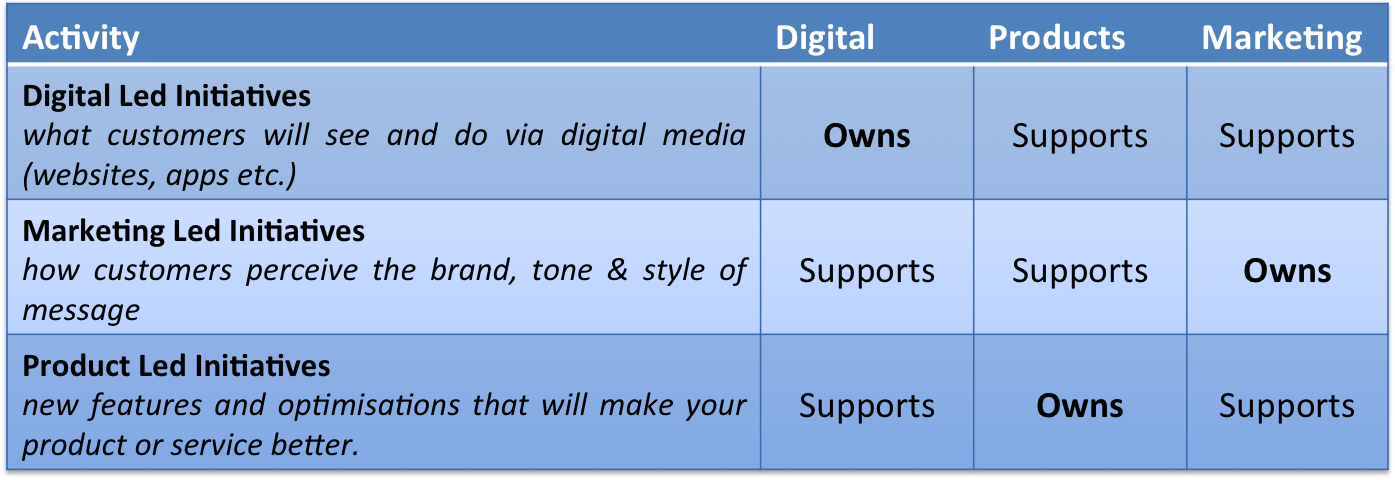
In this new digital landscape, there is a tremendous overlap between what Products, Digital and Marketing do.


All three believe they own the digital experience. 

All three believe they own the customer contact strategy. 

All three believe they own the packaging of the message. 


And that creates inconsistent customer engagement.


Any organisation stuck in this loop has to define the boundaries for digital media. And that can be done by defining categories of "work":


By defining where parts of your customer journey fall in the above, an organisation can start tackling the confusion and create consistent customer treatment. I look forward to your feedback and hearing if your organisation has found a way to remove the noise.


Claims for the digital future.

In the battle to become a great digital organisation, the fight is currently taking place on two fronts - capture as much data as you can and secondly, build a fantastic user experience.

The challenge with data is that most organisations end up becoming data junkyards - where mountains of data is waiting for a superhero analyst to come and make sense of it all. Most companies have started to tackle this in a "Wall-E"-esque way, where relevant insights about customers is pieced together, one product at a time. A few organisations tackle this by customer, piecing together insight on their most valuable segments and providing an awesome experience for those customers.

One thing still remains true: business intelligence is hard. Bloody hard.

Looking ahead at how technology and the market are moving, it is probable that business intelligence will become a lot easier. Three reasons come to mind:

1. Companies will provide Omni-channel customer experiences. Once you stop caring about what channel the customer is in, and you start linking the journey across channels, you take away the headache of building custom channel experiences. Your channels will be controlled in one place. Awesome.

2. Companies will become Device Agnostic. Once wearable technology becomes mainstream, you will no longer be able to keep up with individually tailored solutions for each type of device. Mobile, Desktop and Tablet - will all merge and eventually all you will care about is whether your one common user interface provides an jaw dropping experience or not. Double Awesome.

3. Companies will finally care about privacy and user preferences. The Internet is going the same route as the TV, mainly because it is a targeted media being used in an un-targeted fashion. We're only just realising that. And therefore, by providing the control to users, on customising their experience with your brand,  you will create more loyal followers. This makes it easy for you to send targeted messages to customers - when they want, how they want, and where they want.


The one question that remains is how quickly can you get to a state where channel, device or targeted messaging no longer matters? And what are the obstacles in your industry that are preventing you from getting there? Are you winning the battle today, but losing the war tomorrow?


Tuesday

Fads vs. Trends

Fads are furious and short lived. You need to quickly position your product offering to where a fad currently is. Throw all your short term resources at it. Coming up with extensions will keep the fad going, but it will inevitably die out soon. Then you must look for the next fad.

Trends are slow to build and long lasting. You need to position your offering to where you believe a trend will be. Build your expertise and long term strategy to meet a trend. Extensions are not as necessary and can take on a life of their own. Once you lock into a trend, focus on keeping a competitive advantage.


Love fads. Love trends more.

Thursday

Context matters.

The Wife and I were looking for apartments to rent in London last week. We must have met around 6 real estate agents and seen many more properties. One of the noticeable aspects of the sales process was how important context was to the types of questions asked by the agents.

Only 1 out of the 6 agents asked us how many houses we had seen earlier. When you think about it, the answer to that question determines a lot. If it was the first house we were seeing, it would take something exceptional for us to say yes. If it's the 20th house, we have a lot of reference points to compare the property to. Obtaining this background allowed the agent to customize how she was showing us the properties. Incidentally, we ended up picking a house she showed.

Companies that sell their products online should operate in a very similar way, and the process is faster as well. If I were purchasing shoes, I should be shown related products that match my interest. Depending on where I am in the purchase process, I would be interested in exploring other options, or quickly hone in to the exact product. Either way, the site should be ready to accomodate my needs and consider the context. I feel that most sites do a inadequate job of determining this. Amazon does it well. If you have a business where you are selling products online, how well do you take care of context?

You Only Get One Shot.

Eminem rapped in 8 Mile, "If you had one shot, one opportunity, would you capture it? Or just let it slip?".  Social media works in a somewhat similar albeit less dramatic fashion. Do things right, and your business could have millions of followers that grow at a steady pace. However, make a mistake and most of those fans might leave and never come back.

One of the biggest mistakes is poor content. If you have loyal customers that are willing to track you down, follow you on Twitter or like your Facebook page, then at a minimum you need to keep them there. It doesn't take much. Brands like Barclays quickly realized the price of not having great content and then losing the attention of millions of fans. Don't make that mistake. You have an audience, so go out and wow them.

Wednesday

Marketing 3.0

The evolution has begun - are you ready?

Marketing, both as a science and job function, has evolved greatly in the past few years. From the advent of social media advertising, the relationship between customers and marketers has become more equal. Earlier, marketers could come up with a campaign that targeted their captivated audience through very precise channels. It was okay not to measure every single aspect of a launch. I call this Marketing 1.0.

Now the audience is distracted, informed and definitely more alert. Marketing campaigns need to be managed at multiple levels, with new customers flowing in and out of different channels. The biggest mistake an organization can make at this time, is use the same old principles to manage their ad campaigns. Setting up a social media presence without asking basic questions about your aim can be disastrous. Most firms have realized that, and now have dedicated and sophisticated social media advertising units. The best ones keep a captivated batch of loyalists coming back for more. (See: Red Bull). This is Marketing 2.0.

As organizations get better at recording data, measuring success ratios and creating specific campaigns for social media- the question is, what does Marketing 3.0 look like? The latest flurry of activity indicates that content is still king, and will increase in value over time. Content has always mattered, however, content used 'as media' is new (See Mitch Joel's blog on Marketing Agencies of the Future). Netflix has shown media agencies the way by creating their own shows and offering content that no one else can.

The same principles can be applied to organizations that create their own in-house newsrooms. By siphoning off content and marking your territory, customers are being told that "we offer something that no one else can". It would be interesting to see where this leads. My guess is that it will create more fragmented content in an already fragmented world. This in turn would feed into the impatience and luxury of choice that the audience already suffers from.

The question is: How does the media agency of the future handle it? How does an organization trying to build a brand deal with it? How do you gain credibility in a world where the customer gives you their attention for only a fraction of a second while your competitors distract them by colorful hand waving? Marketing 3.0 will be about creating fierce loyalists and giving them tremendous value in return for their loyalty. It will be about creating multiple fragmented products that can be customized with ease and tailored down to the individual. It will be about ads that are personal and displayed on media that enables one-on-one interaction. It will be more intimate and responsible than marketing has ever been. As a customer, that is amazingly good news. As a marketer, make sure you are ready to deliver in this new world.

Sunday

In a recent assignment, we were asked to capture the essence of the INSEAD MBA experience in under a minute. Here it is:


Score Your Core.

If I were to ask you - what is your core product - how long would you take to answer? Your product, which could be a good, service or an idea - is why you are a business at the end of the day. But in a time of mergers, acquisitions, spin-offs and subsidiaries, the core product frequently gets lost in transition.

Spend some time thinking about your core product today. What have you done in past quarters to develop or strengthen it? Is it getting the adequate attention it deserves? Is your core product different from what it was when your business began?

At the end of this, you might walk away feeling comfortable that your business development is still aligned with your core competencies. Or you might be surprised to learn that your flagship product is no longer at the center of your business strategies.

Social Media Marketing

Social media marketing can be used as a powerful tool by marketers in order to reach their target audience in ways that were previously not possible. It is not only a way to reach your consumers but to also connect with them and get valuable feedback. Some of the basics involve a presence on Facebook, Twitter and other social networking sites and there are many businesses that do this today. But to extract the maximum benefits from this network, companies need to build upon this presence and set up some mechanisms to check the pulse of their market. For those that are new to the world of social media marketing, a good place to start is this book.

A trend that I can see developing is that with the plethora of social networking sites, there will be a need to consolidate this information in one place, for marketers. Similar to how a supermarket consolidates basic utilities for our convenience and how datamarts allow applications to consume data from a central repository - I see the emergence of something I call - "sociomarts". A sociomart would be a type of enterprise social supermarket, where marketers can extract information about a particular set of consumers, or a consumer, from one location. It would pull relevant information from the different social networking sites to compile one "profile" for your target audience. Through this, trends and meaningful information can be gleaned.

Neuromarketing

Neuromarketing. Scary, scary concept. Talk about an invasion of privacy! This new technology basically means that through a series of brain images, a researcher can tell what we are thinking. As a consumer, there can be no more discomforting concept than corporations gathering data about our true opinions and feelings without much trouble.

Of course, this technology is not ready yet. Gathering brain images isn't as trivial as turning on a light switch. But imagine if it was? Most stores would install a brain reading image at the entrance of their store. They could store crucial information about our shopping experience as we leave the store. Our mood as we enter it. The amount of information that can be gathered is astounding.

Remember "Minority Report", where the ads were displayed as scanners read Tom Cruise's eyes? That might be a reality some day.


Legal, ethical and moral issues aside (although there are many), technologies such as these would exacerbate the growing issues between consumers and producers. Consumers already feel bombarded with advertising, where every inch of space is being maximized for publicity as part of some campaign. Something to consider is that when introducing such a technology in the market, what's in it for the consumer? And don't say improved service - because that usually considered more of a right rather than a benefit. If there any additional advantages for a consumer, it would make it easier to adopt. Until then, all this technology would seem to satisfy is some marketer's wet dream.

Saturday

The Customer That Never Was

I ended up waiting on a busy New York city street today. Right next to a Bank of America ATM branch at the corner of an extremely crowded intersection. And I didn't expect to learn a lesson in storefront dynamics.

Being on a corner, the ATM branch had two entrances and one of them was locked without any signs indicating that there was another entrance around the corner. It was an extremely crowded street due to a nearby fair and there was a steady stream of traffic into and out of the ATM vestibule. In the 30 minutes that I was waiting there - about 15 people struggled with the locked door - and 6 of them left without checking the other side. That's a loss of 6 customers who would have done some sort of a transaction.

6? No big deal, right? But take another look at the context. With restaurants, banks and similar services, when people need to avail of the service, it is usually due to something they need to get done. Replace this ATM branch with ... I don't know ... a hair clip store. And now apply the same scenario. Rarely does someone have to buy hair clips. My guess is that more people would try that locked door, not bother any further, and move on to something else. A simple sign could have minimized some of this damage, not eliminate it, because you cannot guarantee that someone will see the sign. But this example just goes to show that even before the customer has entered the store, the buying experience has begun. Make sure you are on top of your game right from the start.

Tuesday

A Brand of Their Own

The financial firm I work for has been going through a long and complicated acquisition with an equally large firm. The effects of these merger are still being felt after many months. The team that I work for has a new name, a new charter, new mission. However, our immediate management is still asking the question: How do we brand ourselves?

I never thought about our brand. We're an internal team - our clients are within the firm. So that question got me thinking about internal branding. Very easy to neglect, because when we think about branding - we're thinking clients, the outside world, outside the firm, outside the industry...them.

I would think there are 2 indirect benefits of internally branding your team well.

1. Visibility - I say this because a team that brands well works together to keep up a consistent image. This image, assuming its positive (because its equally easy to create a negative image), can translate to visibility and through it recognition.

2. Internal branding also can create strong work ethics. Because if you start treating other teams within the firm as you treat your clients, you can never be accused of having double standards. An internal unhappy client can do as much damage to your reputation as an external one.

It is the responsibility of higher management to identify and create these internal brands. And maintain the ones that already exist. Because, these internal brands are more tangible and more real to your employees, especially in a large organization. And because the strength of all these externally invisible mini-brands ultimately translate into success for the externally visible one.

Toggling metrics capture within web services

When creating reusable web services, if you have set up an architecture that stores metrics about every request that comes into the system there are a few traps to avoid. One of the issues our team ran into recently was when a web service called another major web service. We noted that the metrics from the inner service overwrote any metrics set by the calling web service. The work around was to reset all the metrics as they were after the inner service was called, for which a lot of redundant code had to be written.

The solution is to build a metrics toggle into your web services. This flag determines whether metrics should be recorded or not. But a big drawback is exposing such a schema to a client. If a client wanted to, they could misuse the service by setting the metrics flag - effectively rendering your metrics capture useless.

Can't think of a better solution for now. Just a reminder to not quit my day job.

The Lid is Flat

Consider the design of your shampoo bottle - more specifically, how the lid has been designed. If the lid is flat, it means that once your shampoo is running low, you can keep the bottle upside down and use the remaining bit. But if the lid is curved, then it presents a challenge. You will prop it up against something and extract the remaining, or wait patiently for small bits to fall into your hand every time, or throw away the bottle after some time.

1. Is the feature good for the business? Yes, the sooner you give up, the sooner you are a potential buyer.

2. Is the feature good for the consumer? Probably not, because it reduces convenience of use.

In the shampoo industry, brand loyalty is scarce. About 70% of shampoo consumers would switch brands if their brand was not easily available. All the more reason to eliminate any negative features. But this is an example where a feature is good for business while not being good for the consumer. Easier said than done, but such features need to be minimized to create a popular product. The fewer such features you have, the lesser the disconnect is between the wellness of business and the wellness of the consumer.

Monday

Music and advertising

A trend I've noticed with ads is to include the name of the song being played during the commercial in one of the corners. An example is the GEICO commercial with the cavemen, with Three Doors Down playing in the background. This is just another way to create mental links between the product and the audience.

One of the primary goals of adverts is to associate the product with the different senses. An ad can be considered a success when unrelated events can make a consumer think of a product. Heineken has sponsored the UEFA Champions league - a premier European football (soccer) tournament for a few seasons. In this commercial, all the elements come together - the music, the colors, the sport and the beer. Football fans might just find their throats getting a little parchy upon hearing that theme song. Popularity can also be garnered through catchy jingles. How many times have you found yourself humming the Kit Kat song? "Gimme a break, gimme a break, break me off a piece of that....."

So why put the name of the song blatantly during the commercial? One negative is that it takes away the attention of your audience, however momentarily. But the advantage is that it works for the lazy, quick-fix, short-attention span TV audience of today. We know that if we know the name of a song, a download is probably just a click or two away. And especially by gearing the ads towards a younger audience, you can create an association with not only fans of that band, but along with the fans of that genre of music.

For a marketer, it is as much of a success if the audience doesn't pay attention to the product but pays attention to the song. With repetition, and some luck, those Three Doors Down fans might be buying some car insurance.